
E85 Flex Fuel
Counter to how it may sound, Flex Fuel is unfortunately not the newest fitness supplement to hit the market. However, it is a key technology that can aid you and many others in utilizing E85 fuel in your vehicle. If you’ve recently read our latest E85 fuel overview article then you may be left wondering how exactly you can set your vehicle up to take advantage of all of the great benefits that E85 has to offer. With Flex Fuel technology this is easier than ever before to take advantage of all the benefits that ethanol-based fuels have to offer. Join us as we peel back the cob on what Flex Fuel is and how it can help in adding performance to your ride!
What is Flex Fuel?
Traditionally, if you were looking to operate your vehicle on a fuel other than what it was designed for, such as E85 or racing fuel, you would have to not only install the correct components to support that fuel, but also would have to change your vehicle’s tune to one that is calibrated specifically for that fuel type. While this may sound simple enough, this process of ensuring that you have fully drained your existing fuel, filled with the new fuel, and then successfully changed your tune can become cumbersome and annoying over time. With Flex Fuel technology you can now switch from standard gasoline to E85 fuel, or any mix of the two, on the fly without the need for monitoring your ethanol content or having to store and flash multiple tunes.
The way that Flex Fuel can provide this level of simplicity is by using a sensor installed on the vehicle to transmit information back to the engine control unit (ECU) telling it what the ethanol content of the fuel is at that given time. Once the ECU has determined the ethanol content, it can then make changes to the vehicle’s calibration in real time to compensate for that fuel type. To actual sensor(s) used to determine ethanol content in a vehicle will vary based on the vehicle type, but there are two primary strategies for gathering this information.
Flex Fuel Sensors
The first strategy is to use a Flex Fuel sensor that is installed in-line with the vehicle’s fuel system. The sensor has an inlet and outlet in which fuel from the tank can flow through, and the sensor can detect the ethanol content of that fuel as it passes through. The sensor then has a direct line of communication to the ECU which can then interpret that signal into ethanol content.
Because the fuel is flowing directly through the sensor this is by far the most accurate and effective method of interpreting ethanol content. This is the standard method used in many GM vehicles as well as used in many aftermarket Flex Fuel kits. Unfortunately, not every vehicle or ECU can support this type of system, so an alternative method called inferred Flex Fuel is required.
Check out of this method of Flex Fuel conversion, as used on A90 Supra, in the video below!
Inferred Flex Fuel
For vehicles that are unable to support an external Flex Fuel sensor, the option for inferred Flex Fuel may be available. The strategy of inferred Flex Fuel relies on oxygen sensors placed in the vehicle’s exhaust system to return information back to the ECU that can then be interpreted into an ethanol content. While this may sound confusing at first, the method is actually quite simple. As exhaust gasses pas by the oxygen sensor(s), they will send back a voltage signal to the ECU. The voltage signal that is sent back will vary based on the air/fuel mixture in the engine at that time. Because E85 and gasoline have very different stoichiometric values (ideal ratio of air and fuel to support combustion), the voltage readings will be very different when each fuel is applied. The ECU can then use this information to determine what fuel is in the vehicle at that time and adjust the calibration accordingly.
While this method may sound better due to its lack of additional parts, the fact is that it is not the most accurate way of determining ethanol content and should be implemented with caution. Inferred Flex Fuel is a reactionary strategy meaning that it takes some time for the engine to run before the sensors will pick up the change in signal and have time to make the necessary calibration changes. Also, other mechanical variables that cause changes in air/fuel mixture, including something as simple as an exhaust leak, can cause improper oxygen sensor readings that can lead to an improper change in the vehicle’s tune.
Check out our Inferred Flex Fuel calibration for Ford Mustang in the video below!
Flex Fuel Conclusion
With the growing popularity of E85 and the huge performance benefits that result from using it, it is easy to see why Flex Fuel technology is extremely beneficial in vehicles that want to utilize this fuel type. Not only is the process of switching between pump gasoline and E85 made easier than ever, but there is also a large safety benefit available. Traditionally E85 tunes will run much more aggressive parameters that can be dangerous when lower octane fuel is in place. In instances where a bad batch of E85 with an unexpectedly low ethanol content may enter your fuel tank, a flex fuel sensor can be an engine-saver by softening the tune based on the actual content realized by the sensor. For this reason, we believe that Flex Fuel technology is a critical piece for any vehicle using ethanol-based fuels.
If you enjoyed this article and would like to learn more about the specific Flex Fuel system applicable to your vehicle, or if you would like to schedule an appointment for a Flex Fuel install and tuning session, then give our team of performance consultants a call today!

What Is E85? Benefits and Drawbacks of E85 Explained!
E85 – Race fuel performance at gasoline prices!
Have you noticed the new pump handles at your local fuel station that say “E85” and wondered what they are all about? What if we told you that this is the key to unlocking more horsepower from your engine while also helping it run more efficiently, and all for less than what you’re paying for premium gasoline? E85 fuel provides these benefits and more which is why we call it the automotive “nectar of the Gods”, but there are a few things to consider before pulling the trigger on the yellow pump handle. In this article we will take you through the good, the bad, and the beautiful of running this fuel in your vehicle, but if you simply want to see how you can add more power to your ride with E85 then our team is standing by on the phones to answer your questions today!
What is E85?
E85 is a fuel that consists of a mixture of ethanol and gasoline. Ethanol is alcohol that is derived from plant matter such as corn or sugar cane, and when used as a fuel for automotive engines it can provide properties that allow for increased performance. However, most vehicles cannot operate on ethanol alone as this fuel is very corrosive to fuel system components in its isolated form, as well as it requires much more energy to ignite making it difficult for engines to start on ethanol in cold temperatures. To overcome these two issues traditional gasoline is blended with the ethanol. This provides additional detergents to the fuel to protect against corrosion, as well as lowers the energy required to ignite the fuel so that vehicles can easily start in cold climates.
Benefits of E85
To fully understand the benefits of E85 fuel you must first be aware of the actual ethanol content in the fuel you are filling with. In the United States E85 fuel can range from an ethanol content of 50% to 85% with the remaining content of the fuel being traditional gasoline. The actual mixture that you will receive from the pump will vary based on the region that the fuel is being sold in as well as the time of year as the ethanol content is reduced to help with those cold-start conditions that we mentioned earlier. The main point here is that the performance benefits from E85 fuel will increase as the content of ethanol increases in your fuel.
Now that we understand ethanol content in E85 fuel we can look at what key factors actually allow engines using E85 to outperform those using traditional gasoline:
-
- Octane Rating – The first factor to consider is that E85 carries a higher-octane rating than standard gasoline. Depending on the final ethanol content of the E85 being used the octane rating can range from 100-105. This is a significant increase from most premium gasoline in the United States which only carries a 91-93 octane rating. By providing a higher-octane content the engine can safely run higher boost pressure and/or ignition timing with a lower risk of detonation. Prior to E85 being readily available this level of octane was only found in very expensive and hard-to-source racing fuels, but now E85 provides this same level of performance and protection at your local pump and for a cost that is generally lower than premium gasoline.
- Cooling Effect – E85 also provides a significant cooling effect that is not found in gasoline. This cooling effect will provide lower temperatures in the combustion chamber during the ignition process which allows for a safer environment in high-performance engines that run high boost pressures or ignition timing. Also depending on the fuel system in your vehicle, some engines may experience a reduction in intake air temperatures that can lead to an increase in horsepower as well.
Due to many variables in combinations it is impossible to put a general number on how much horsepower and torque will increase on E85 versus gasoline. However, it is safe to say that any vehicle will show a performance increase by using E85 as long as E85-compatible components are installed and the vehicle’s ECU has been properly calibrated for E85 fuels. These benefits coupled with the low cost of E85 make for a compelling argument to change your vehicle over to E85.
We ran tests between E85 and other fuels on our A90 Supra test vehicle to see how it stacked up. To see the results, watch the video below.
Drawbacks of E85
While the additional performance at a low cost with E85 is significant, there are a few additional factors to consider before deciding that E85 should be the preferred fuel for your vehicle.
-
- Vehicle/Component Compatibility – The first item to consider when deciding to switch to E85 fuel is whether your vehicle is equipped to safely use E85. When comparing a vehicle on gasoline versus one on E85 with identical combinations, the E85 vehicle will demand 30-35% more from the vehicle’s fuel system than the gasoline vehicle. Because of this, most vehicles will require some form of fuel injector and fuel pump(s) upgrade before it can support E85. Also, many manufacturers did not provide ethanol-compatible fuel lines and components until the mid-2000’s, so it is best to discuss exactly what is needed to run E85 in your specific vehicle with your performance consultant prior to making the switch.
- Fuel Economy – E85 vaporizes at a rate of 30-35% on average faster than traditional gasoline. Because of this, vehicles that operate on E85 fuel will typically see a reduction in fuel economy by that same 30-35% rate compared to what the vehicle would experience on gasoline. However, E85 is generally less expensive per gallon than premium gasoline so for most users this is not a significant concern.
- Availability – While the availability of E85 fuel has drastically increased in the past several decades there are still many areas that do not have reasonable access to E85 at a traditional fuel station. Due to being produced primarily from corn matter, E85 is prevalent across the mid-west as well as larger cities where fuel transportation is frequent. However, regions that are more scarcely populated and located further from corn-producing areas may have more difficulty sourcing the fuel.
Is E85 Right for You?
Now that we have explored some of the benefits and drawbacks of E85, it is time to decide whether E85 is the right fuel for your specific vehicle application. After you’ve spoken with your performance consultant on what components will be needed to equip your car to be compatible with E85, the next step is determining the availability of E85 in your area as well as if you are comfortable with the reduction in fuel economy when using E85.
There are many resources to determine the availability of E85 and other ethanol-based fuels in your area. Most notably is www.gasbuddy.com which provides you with an easy to use search engine that locates all of the available fuels in your area based on your location. When conducting your search, you may find that E85 is not readily available in your area, however that should not put a stop to your consideration of E85 as many aftermarket fuel manufacturers such as VP Racing Fuels are now offering their own versions of ethanol-based fuels that can be ordered online and shipped directly to your house or local performance center. If your vehicle is more of a weekend warrior this may prove to be a great solution to increase performance without worrying about where to fill up.
The reduction in fuel economy is also easily justified by the traditionally lower price per gallon of E85 when compared to premium gasoline. While the reduction in fuel economy is real, the benefits of a higher performing and safer engine far outweigh the extra trips to the pump.
As you can see from this article there are many advantages to using E85 fuel in your vehicle and our team of performance specialists are happy to help in answering any additional questions that you may have about making the switch. Every vehicle application and combination differs slightly, and National Speed is equipped with the tools and resources to help in guiding you on a path to increasing the performance in your vehicle without compromising safety or reliability.

Designed to Dig: Torsten’s 2009 Nissan Alpha Performance GT-R is Designed to Hit Low 8’s
Many people dream of being able to cross the quarter mile line in under ten seconds, and now most days with enough determination and work you can make it happen. However, things start to change beyond that.
Torsten came to us with one of the greatest platforms for attempting the feat of a monster quarter mile time, a 2009 Nissan GT-R, and an ambitious goal, to design and create a car that is both daily drivable and able to achieve a quarter mile time in the low 8 second range. We were happy to oblige him and take on this project.

Our Performance Consultation team met with Torsten to create a game plan to make his dream of an 8-second daily a reality. It’s always a pleasure to work out the vision with our clients. With Torsten wanting the best of both worlds, a daily driver with a blistering quarter mile time, our build team began from the bare bones. The VR38DETT was pulled from the bay and was replaced with an Alpha Performance 3.8L Short Block to create a near bulletproof base with 1000hp+ potential for this monster daily.

Topped with a Boost Logic V2 intake manifold with 12 Injector Dynamics ID1050x injectors, ported heads from HeadGames Motorworks were installed along with Stage-2 camshafts from Kelford Cams and a GSC valvetrain to finish up the top end with strength and durability.
To crank up the boost, the stock turbos were replaced with quick spooling Extreme Turbo Systems G-Series GTX3582R Gen-2 Turbochargers.
Alpha Performance also supplied the Omega twin-pump brushless fuel pump system along with other fuel system components from T1 Race Development and COBB Tuning, completing the fuel system.
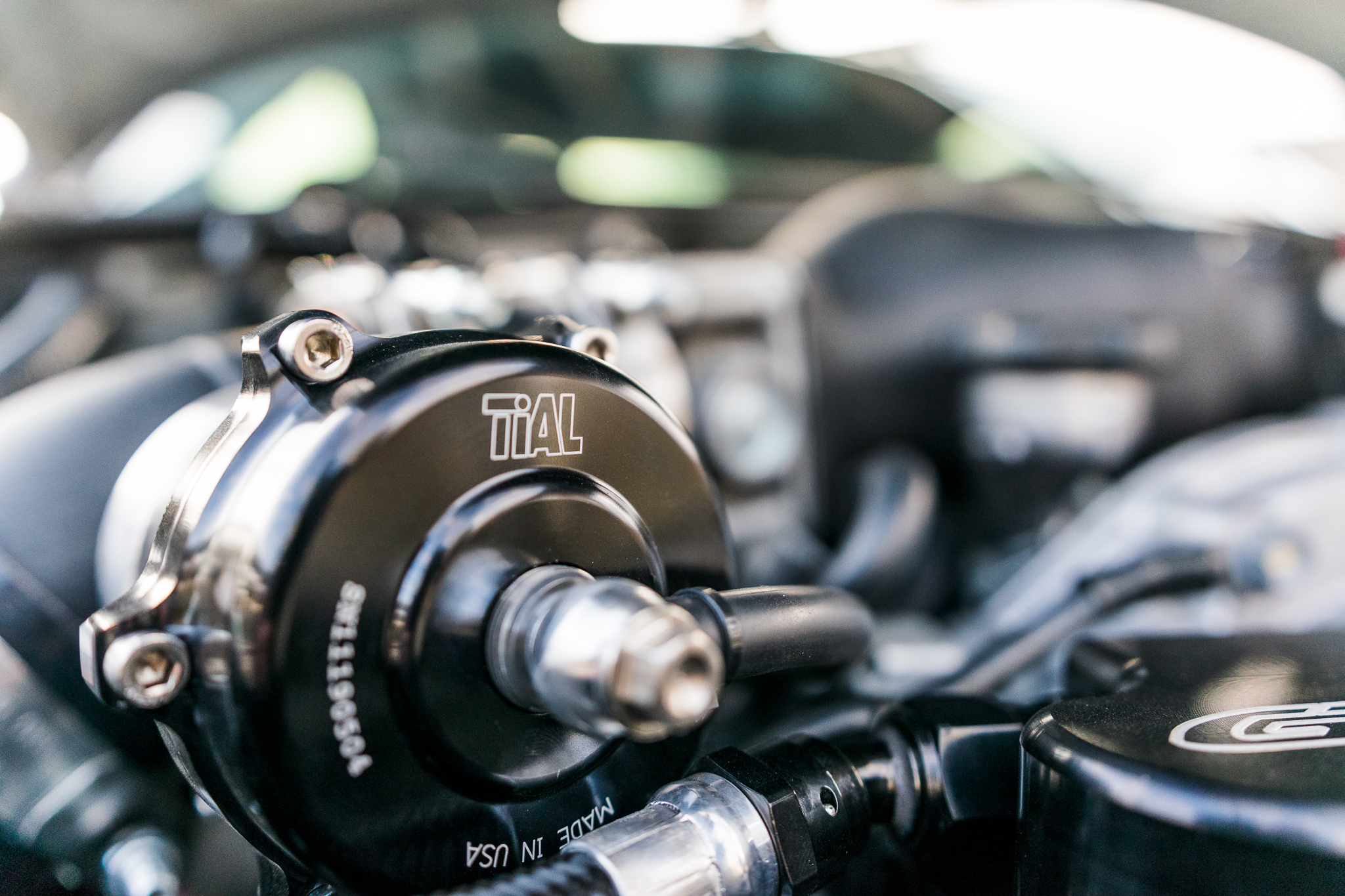
In order to let her eat, we have to let her breathe, and with an Extreme Turbo Systems race intercooler system with TiAL Sport Q 50mm blow-off valves, we were able to support the turbo system and achieve our 1000HP+ goal. Our friends at Extreme Turbo Systems also supplied the 3.5” to 4” Pro Series Y-Pipe to 4” Exhaust, getting us that signature VR38 sound.
Keeping everything together are ARP Fasteners and Genuine Nissan OEM gaskets, seals, and other miscellaneous components used to assemble the engine. With the end product being a daily driver that is able to hit Torsten’s goal of low 8-second passes, we had to make sure that this engine was solid and efficient for run after run, followed by the drive back home.
The team at Jack’s Transmissions put together the perfect gearbox for this build, a fully built Drag 1000 GR6 Transmission, taking all the raw power from the Alpha VR38 and sending it to all four wheels.
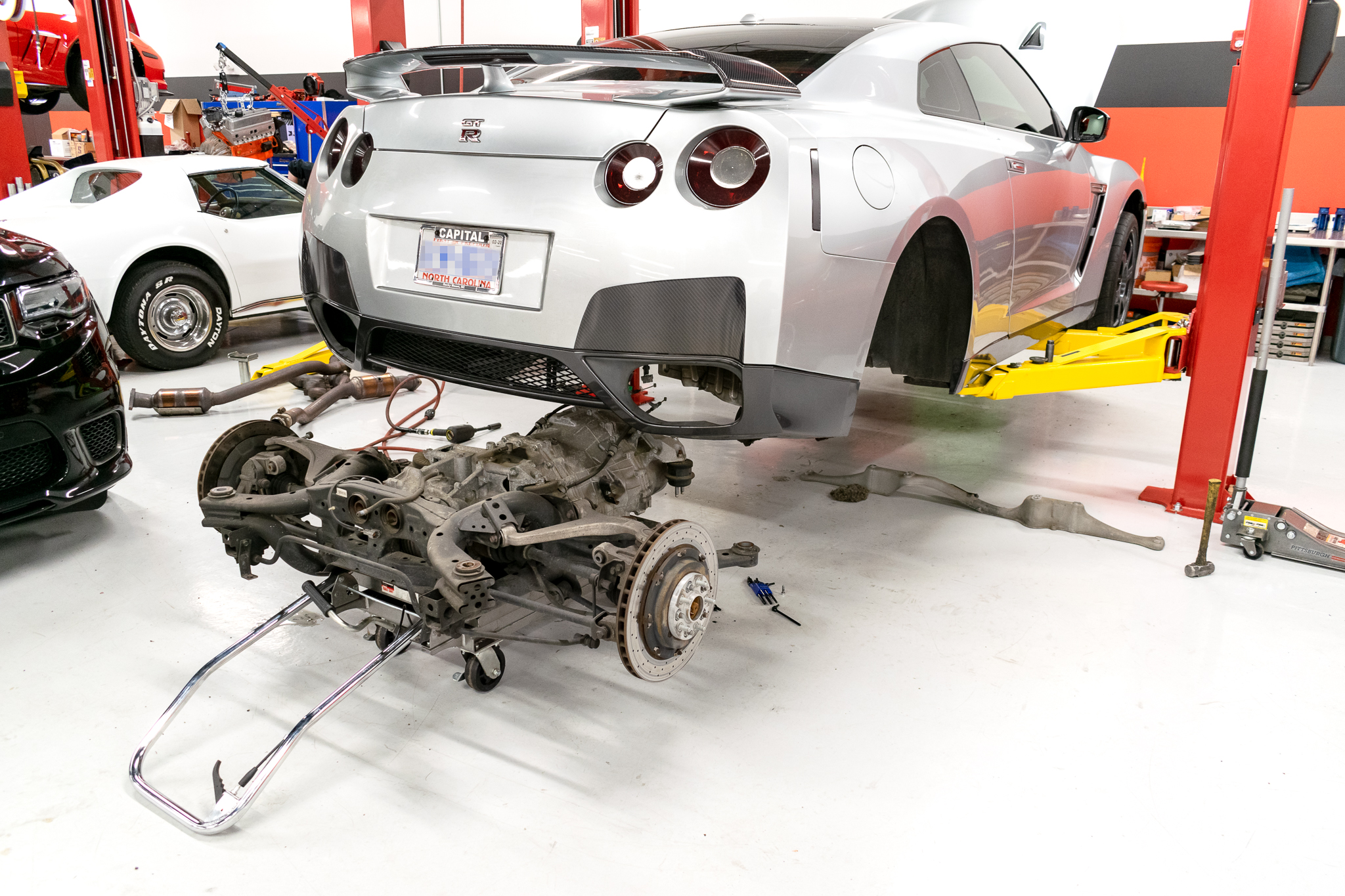
In order to put all this power to the ground successfully and reliably, we tapped the team at Driveshaft Shop to get a 1000HP+ Pro-Level rear axle, hub, and differential stub kit built and ready for Torsten’s GT-R. Tuning the all-wheel drive system is key to a successful launch, so we used a STM Tuned AWD controller to fine tune the power delivery.
To help Torsten control this beast, we finished up the build with an Alcon big brake kit in the front and rear and wrapped his wheels with some sticky Toyo R888R Tires.

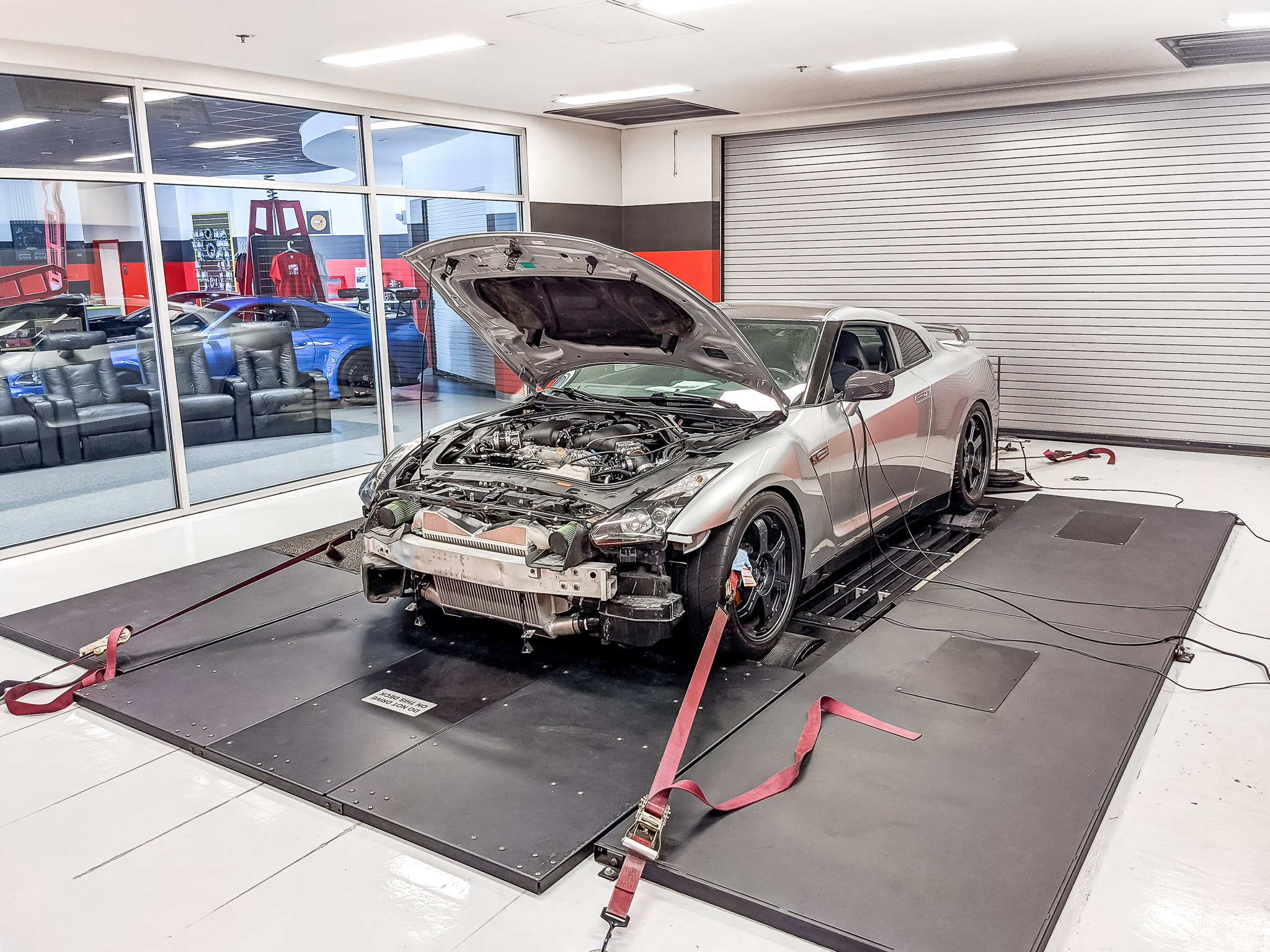
With all the pieces finally together and ready for tuning, Torsten’s GT-R hit our in-house dyno to see what it could do. Using the COBB Tuning Accessport V3 with TCM Support, our tuning team calibrated the system for Flex Fuel capability for ultimate control over the car and tunes. For our dyno tests, we would be testing with standard 93 octane and E85.
Strapped down and with our ears singing with the glory of it’s fully built VR38, Torsten’s GT-R exceeded our goals and laid down a mighty 1,355whp and 972lbft of torque on E85 and a comfortable 882whp and 664lbft of torque on your everyday 93 octane.
To celebrate, we unstrapped the car and took it out for a quick shoot and loved everything we saw. This GT-R is truly a wolf in sheep’s clothing.

With the beast built and our goals achieved, we’re looking forward to seeing what Torsten and his GT-R can do at the drag strip. Knowing the great things our team can do, we expect to see a low 8 slip in the very near future.
Torsten’s GT-R build is a reminder that no goals are unachievable with the right team and determination.
For a closer look at this build, take a look at the full gallery.
Reach out to National Speed today to see what we can do for you!

Deeper into the 9’s with Sean’s 860WHP 2016 Camaro SS
Deeper into the 9’s we go, with an assiduous quest for 8’s!
Sean has been a long time National Speed client and GM performance car fanatic, owning and restoring a gorgeous 1964 Nova SS, and for the past couple years, his dedicated performance car, a Mosaic Black Metallic 2016 Chevrolet Camaro SS.

For the latest evolution of Sean’s never-ending quest for more power, a simple goal was laid out: 850+whp on 93 octane.
The car has lived through several iterations over the five years of Sean’s ownership, starting from a bone-stock, brand new platform straight from the dealership. While all was fine for a while, Sean had a craving for something more, and after spending multiple weekends at the dragstrip, the need for more power could not be contained.
With the original engine-out build yielding him some great results. throwing down a tire-slaying 9.98 quarter mile at Coastal Plains Raceway Park Dragway, it was clear the existing setup needed to be updated. Unable to suppress the desire to see how far we could really push the LT1, a plan was set in place to completely tear down and rebuild the 6.2L LT1...for the second time.

With the Camaro back in the shop, our Performance Technician, John, made quick work pulling the engine from the car, tearing it down to the bare short block. From there, he meticulously gapped each piston ring to the exact spec needed and in went a Gwatney Performance Innovation complete drop-in piston & rod package. This specific package includes Diamond Pistons 2618 pistons with rings, Callies Performance Products 6.125″ connecting rods, connecting rod bearings, heavy duty wrist pins, locks, and rings. To compliment the new pistons and rods installed, in went a custom designed 5150 billet-core VVT camshaft from Cam Motion.
While John was working away on the bottom end, we tapped the great team at Gwatney Performance Innovation again for their ported cylinder head service and installation of Brian Tooley Racing valve spring set. Once the heads were finished with their revamp, John finished up the engine internals with a COMP Cams high pressure fuel pump lash cap, OEM LS7 rocker arm pad, and all the various gaskets and seals to complete the installation.

With the internals beefed up and the motor dropped back in, it was time to work on some more power! While Sean was able to make a solid 740.05whp & 694.24lbft on E50 at only ~12.5psi on his old setup, a Magnuson Superchargers Heartbeat TVS2300 supercharger, we decided to up the ante and go with an even bigger setup from Magnuson Superchargers, the Magnum DI TVS2650R! To dial in more boost, a smaller upper pulley was needed, so John swapped out the existing upper pulley for a smaller 80mm unit, then added a 103mm SD103LTX throttle body upgrade from Williams Performance, allowing the most amount of air into the TVS2650R. Finishing up the engine build, John installed a set of LTR7IX-11 spark plugs from NGK Spark Plugs attached to a set of premium spark plug wires from Katech.

With the drivetrain set, it was time to figure out how to get the power to the ground. The stock wheels, control arms, and wheel & brake hub setup were all removed and replaced with a 15” conversion from Carlyle Racing. The stock set was quickly replaced with a set of gorgeous WELD Racing 15×10 S71B Non Beadlock wheels wrapped in Mickey Thompson Performance Tires & Wheels 275/60/15 ET Street S/S radials. To help the car stage correctly and to get heat into those new meaty tires, a line lock kit from SJM Manufacturing, Inc. was installed allowing the front brakes to lock up independently from the rear brakes.
With all the parts installed and mechanical work wrapped up in the shop by John, our Calibration Assistant, Matt, strapped her down to the rollers for Vlad to perform a custom calibration via HP Tuners. With 93 octane in the tank and the Magnuson TVS2650R delivering around 16psi, Vlad and the National Speed team were able to increase the LT1’s output to a kick-ass 863.71whp & 742.04lbft!

For Sean, power has come in stages, originally seeing 546.80whp & 545.77lbft with bolt-ons, 740.05whp & 694.24lbft with the first build, and now with the current setup, 863.71whp & 742.04lbft! With the factory direct-injection system being the only limiting factor in this build, the temptation to switch over to LS-based port-injection is already on Sean’s mind. Hopefully we will see him back here for more fueling upgrades and tap into the 900-1000whp range, finally reaching his goal of 8 second quarter mile times!
Reach out to National Speed today to see what we can do for you!