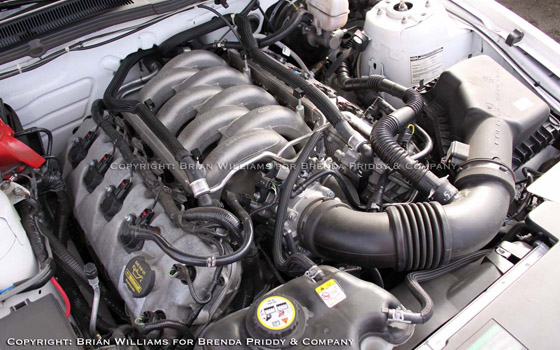
Does intake manifold porting actually do anything on a 2018 or newer Mustang 5.0L engine? (Full Video below)
Now we don’t mind admitting that ported manifolds have typically been considered one of those good modifications to do “while you’re in there”, and given that we’ve seen measurable gains on other platforms this isn’t something that exactly jumped out as being worthy of investigation with the 2018 and newer Mustang 5.0Ls.
We’ve heard gains from individuals all over the place from 5hp to over 20hp from porting alone but realized that we hadn’t seen a real controlled test and since we got on a bit of a comparison kick with our test 2021 Mustang GT, we decided to run the test ourselves removing as many variables as possible.

Before we get into that, let’s review some important details of our testing methodology. First, pretty much all late-model fords have a feature that’s called dynamic advance and with this, the ECU is constantly trying to add or subtract ignition timing to optimize performance for conditions as well as fuel. What that means is that without any change to hard parts or the calibration strategy, you can see some pretty significant swings from dyno run to dyno run. It goes without saying that that’s a pretty glaring variable for what needs to be a controlled test, so with that in mind, for every hard part that we change out we’ll be optimizing the calibration and then disabling dynamic advance for each dyno pull. This means that the only difference we’re showing in the graphs is from intake manifold porting alone and not from the ecu changing ignition timing on its own from run to run.
Second, all these runs were completed in a two-hour window on the same dyno with the same calibrator with very similar conditions. It’s about as controlled as we can get without a laboratory setting.
Alright with that all said let’s get started. First, our test car is equipped with our stage 2 naturally aspirated package. This includes a JLT Performance air intake system and Stainless Power long tube headers connected to the stock exhaust on 93 octane.
Our baseline: With the stock intake manifold came in at 459whp and 422lb/ft.
From there the Mustang went back to the shop to have the ported intake manifold installed and back to the dyno.
The results: After several runs to validate our findings, we saw absolutely no gains whatsoever. Now we’d like to note that this company makes no claims for gains on a stock Gen 3 engine so we can’t ding them here. That said we’re going to be looking for opportunities to perform this exact same test on more heavily modified forced induction gen 3 setups.
In conclusion, if you have a bolt-on naturally aspirate Gen 3 Coyote engine, the odds that intake manifold porting will equate to real gains are low. If you have plans to do cams or turbochargers in the future, it may be worth the investment but, until we test side by side, we’d advise you to save the money.
As always, if you have any questions at all we’re happy to chat thanks for watch